Sunday, September 29, 2013

Snake Pit: Game Deconstruction


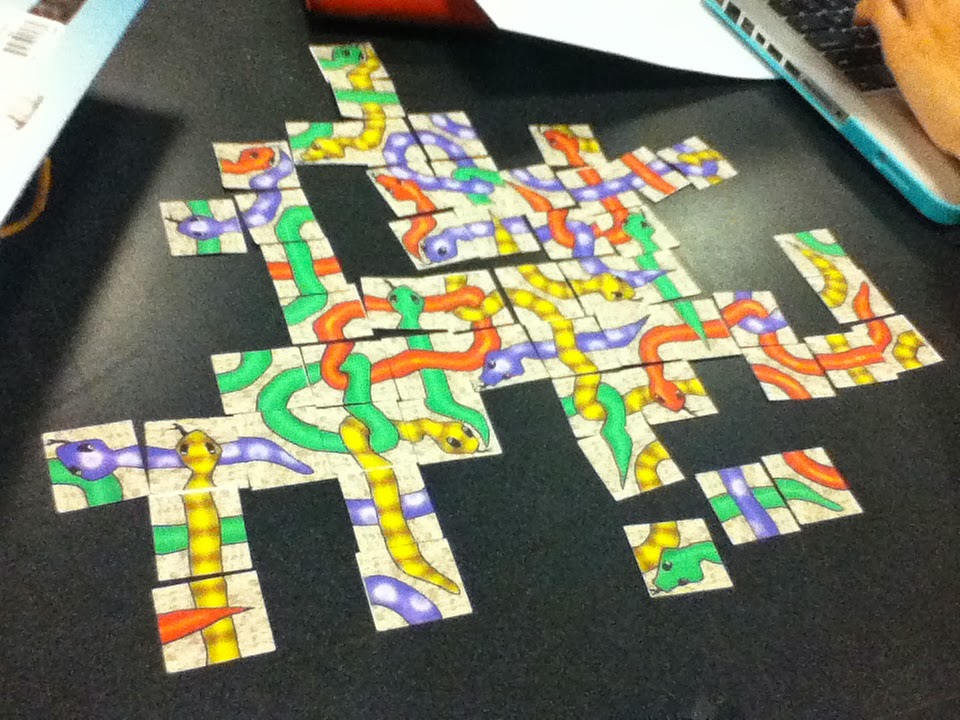
Goal of the Game: The goal of snake pit is to earn the greatest number of points by laying down enough tiles to complete a snake.  This includes either a snake with a head and tail and any number of parts in-between, or a loop.  The game ends either when players run out of tiles, or cannot make any further viable moves.

Core Mechanic: Beginning from a single tile, each player adds two tiles to the game area, extending or completing a snake or loop.  The player can only continue a snake with the same colour as it started (purple extends with purple, red with red, etc.)  Completed snakes may not have a head at either end (or tail).  Points are scored for the length of snake (3 points for a 2 tiled snake, 6 for 3, etc.)


Game Space: The game board is a two-dimensional space, with no set boundaries.  By adding tiles, the players may expand the boarders of the game however they wish, provided that snake parts are of the same colour.  Once placed, however, they are static, and cannot be moved around.  The snakes themselves are rather three-dimensional in nature, some of the pieces featuring parts that overlap and wind above and below each other, but in general tend to only travel in two dimensions.


Objects, Attributes, and States: Objects for this game are 54 separate tiles and 8 optional score multiplier counters.  Each tile contains two attributes: parts and colours.  There are three parts: head, middle, and tail, and those three may turn up in a variety of combinations. The tile also displays the direction with the part is headed (North-South, East-West, or at a 90 degree angle).  Each tile contains up to two colours: red, green, yellow, or purple.  The colours cannot be on the same tile at the same time, and are attributed to each part.  All of these attributes are static throughout gameplay, even with the inclusion of the score multipliers.

The score multipliers come in two varieties: four counters with rattlesnake heads (one of each colour), and four x2 multipliers.  Rattlesnake heads remain in the player's hand, even after being played.  x2 multipliers are placed as static parts of the board.

Operative Actions: The player may place two tiles to extend the game board, and replace those two tiles from the tile bag.  If a player does not have the tiles to make a proper move, he/she may abstain from his/her turn.

Resultant Actions: The player must consider various strategies.  He/she can either extend a snake, in the hopes that his/her opponent will ignore it, or finish it for an unsatisfactory number of points.  Likewise, if a player notices a long snake, they can choose to finish it there, possibly sabotaging the opponent and stealing points from them.  The player also determines how to rotate the placed tiles, and whether the completed figure is a loop or has a head and tail.

Skills players learn: Players focus on their strategy and mental skills, deciding what parts of the board to focus on and what parts to allow the opponent greater access to.  A certain amount of resourcefulness is utilized for the player to figure out how to best make use of the tiles he/she is given, considering that tiles are drawn by chance.  The players also need to have a sense of foresight to predict opponents' moves, as well as see multiple outcomes for every tile on their own turns.

Variants: Snake Pit allows for several rule variants involving the optional counters.  Snakehead multipliers are held by the player until a corresponding colour snake is completed (depending on the variation, this is done by either the player or the opponent), and once revealed double the score of any snake of that colour.  x2 multipliers are distributed to players before the match.  At the end of a turn, they can be placed permanently on a tile.  If a snake attached to that tile is completed, its score doubles.

These two rule variants cannot be used at the same time.

Role of chance: The only exposure the players have to chance in this game is in what tiles they draw.  Other than that, the game relies on the skill of the players.


Wednesday, September 25, 2013

Testing P&P Games: A Lesson in Patience and Rule Reading

As we begin the Tabletop Game portion of Game Design I, our first assignment was to put together some random games from the internet and see how they worked.  After combing through a couple websites, I got together with a few friends, each of us bringing a couple games to the table.

The two games I contributed were called Bad Grandmas, a card game, and Splut! which was more of the boarded variety.  We only played Bad Grandmas, but I’m gonna comment on both because I read enough of Splut!’s rules to understand it.

First off, Bad Grandmas is hilariously irreverent.  I mean, just look at these cards:


Back in my day, we had feet for faces


I could just tell that this game was developed for fun, and the general reaction to the cards was one of shocked, horrified amusement.  There’s honestly no other way to respond to a picture of a grandma wielding a chainsaw.  I also enjoyed the goal modifiers—as long as they didn’t cancel each other out, which happened a lot.

Splut!, on the other hand, is designed to be abstract and minimalist, but the silhouettes are extremely easy to read.  There’s a dark sense of humour to them as well: the game’s title derives from the sound of a rock crushing the heads of your opponents (also happens to be the goal of the game):

Rock, Wizard, Troll, Dwarf

At this point, it’s pretty obvious I chose my games for their senses of humour, and it’s true.  I like humour in games.  If you can’t laugh while playing a game, what’s the point?

The other three games that we looked as a group were 12 Realms (I guess it was a board-style RPG?), Unbound (I don’t even know how to classify this, but it was pretty sweet), and some vampire game that I never found out the title to so we’re just gonna call it That One Vampire Game (card game).  All of them were rather pretty to look at.


Unfortunately, now I need to rip into some of these games with fierce, Tyrannasaurus Rex strength. We didn’t play three of the games mentioned (one because of time constraints).  For the other two, we tried, but gave up, for one reason and one reason only:

The rulebooks.

I can only describe some of these rulebooks as the spawn of Eris, Greek goddess of confusion and strife.  They were rife with long bouts of text with no diagrams, awkward phrasing (“exploit” instead of “use” for instance), and just incoherence.  One book, 12 Realms, had an entire section on a group of cards that weren’t even available for download.  That One Vampire Game barely explained how to set up your cards at all.

If your manual is longer than 6 pages without significant diagramming, just stop.


The concepts for these games were compelling and made me want to play...until I read the rules.  I am playing your game to relax and have fun, not achieve a higher state of enlightenment.  If it takes longer than fifteen minutes to explain the rules game to a group of three intelligent women, and not even the person reading the rules has a clue what is going on because of a completely different vocabulary, you need to rethink yourself.  I will not subject myself to this torture, even if one of the characters’ name is Siegfried.

Unbound and Bad Grandmas ended up having the best rule sets, because they fit on tiny cards that were easy to reference and understand.  Unbound’s designer was even kind enough to have enough rule cards for multiple players, as well as a handbook.


Both of these were smaller than 3"x5"


The one problem with this “half a page” method was that the designers often forgot to add in important rules.  What happens when your Grandmas’ powers tie?  If the rule modifiers cancel out?  In Unbound, how many actions are you allowed per turn?  These are pretty important things, but are mysterious left out for either the sake of space or just airheadedness.  I’m not going to give Unbound the choice of space, because there was a main manual as well.  That needed to be taken care of.

On the other hand, leaving those things out lets the players have a choice in how they shape their game.  Which is nice except when you sit around for five minutes pouring through a manual before saying “Screw this let’s just do it this way”.


As far as playing pieces go, Unbound and Bad Grandmas once again were pretty superior in my mind (Ok, That One Vampire Game was on the same lines, but I'm just ignoring it because no idea what was going on with it whatsoever).  Card games were easy to look at and easy to assemble.  Unbound had smaller pieces, but they were at a minimum, the majority being giant hexagons (not as hard to cut out as one might think).

Splut! was a different story.  The board itself was way smaller than 8.5"x11" when printed out, and the pieces smaller than a quarter!  My clumsy fists cannot hope to God to be able to control those pieces accurately.

WHY


12 Realms took small pieces to the limit.  There were pieces equivelant to dime-sized there.  Easy to lose, easy to disturb and destroy the game, especially for a print-n-play where everything's made of slightly sturdy paper at best.

In the end, were the games we played fun?  Unbound definitely was, even though I sat out of the two-player round.  Seeing the reaction to turning over a trap card and losing a significant amount of progress was hilarious, and sabotage was ripe for the taking.  Bad Grandmas definitely had potential.  I would’ve suggested more cards and sabotage mechanics, as it was pretty straightforward.


The other games, however?  Considering we lost the will to play them before even getting started, I can’t really say much about their fun factor.  What I can predict, though, is this: very few people derive joy and entertainment from building nuclear power plants or running the world’s largest filing cabinet.  Don’t make your game that kind of fun.

Sunday, September 15, 2013

Steve Hickner Presentation

Last week, I attended a couple of lectures by Mr. Steve Hickner, a man who's been making his way through the animation business for over 30 years.  On Friday evening, he chronicled his journey through the industry, and on Saturday he talked about his redos for senior thesis storyboards.  I actually learned quite a bit from both presentations, even though he wasn't specifically speaking to someone in my major.

It's hard to know exactly how to break into any industry, but Mr. Hickner seemed to have the answer: take advantage of every single opportunity, from crappy offices to chance meetings.  A lot of his advice was practical: if you're going to go see a specific director or other influential individual speak, verse yourself in their work so you can create a proper dialogue.  If you want someone's time, ask for a tiny amount of time (they'd be a jerk to say no), then ask a question that'll take way longer than that to finish.  The one thing I wasn't sure of, however, was how to know what kind of a question to ask.  Sure, "something that'll take longer than two minutes to answer" is a good start, but what does that entail?  Asking for an anecdote?  I'm a direct person when it comes to questions, it takes me a short time to answer them and I try to get to the point, so I understand the sentiment but not the content.

What I appreciated most on Saturday was seeing the way storyboarding is done professionally.  My idea of story boarding was Glen Keane-style sketches, but when Mr. Hickner got behind the wheel, it was fascinating to see how he got into the seniors' work.  He had an inclination towards animal side kicks that I noticed, and it made sense, knowing how Dreamworks worked.  He liked to play up gags, and definitely pushed composition as far as he could go while still keeping to his own set of rules.  Seeing how much work went into it was crazy too--I'd done keys before, but story boarding is much more intensive!  At some points he was practically animating the action.

Those presentations were a nice breath of fresh air.  Back to Maya!

Wednesday, August 28, 2013

Freshman Year

Taking a look back at my freshman year, even though it wasn't long ago, is a bit daunting.  There's a lot of crap to wade through, but I still have a few "jewels" (at least, in my mind), that I don't mind sharing.  A couple of them are already on my blog, herehere and here, (All from second semester) but I'll upload some more things too, just because I haven't really done any of that.

First Semester:


Figure Drawing, 1hr pose.  The picture destroyed a lot of the values, though.


Rhythm assignment for 2D Design


Another 1hr figure drawing


Second Semester:


Drawing II Final: Trojan Horse


3D Design: Thorne Room.  Uploading this mostly for the lighting, which was the best part

Aaand another Figure Drawing.  This one got into Best of Ringling so I'm super proud of it.  Wish I had more figure stuff from last semester on my hard-drive...


I feel like I learned a lot this last year, mostly about how I work, and how much I need to ask for help (read: a lot, and more than I currently do), as well as a lot of technical things that were extremely helpful.  Looking forward to another fruitful semester!


Sunday, August 25, 2013

The Last Guardian


Today, I'm going to interrupt my art blogging schedule to talk about the above video.  This is the 2009 E3 trailer for the Last Guardian, a game that, much to my agony and despair, hasn't actually come out yet.  Take five to enjoy it and then read on.

---

The first thing I noticed about this trailer is how it grabs the viewer's attention with both surprise and suspense.  The initial surprise springs from the unexpected jarring of the viewer's sense of scale (comparing the blackbird to the now-enormous feather), followed by the giant clawed foot (with some, might I add, pretty darn flawless lighting).  Suspense follows, created by the drawn-out reveal of what Torico (the creature) actually looks like, and whether he is friend or foe.  Comparing the boy's sprint down the hallway to Torico smashing the guard fits perfectly, making it almost a surprise when the adorable griffin pulls the boy up instead of sending him to his fate.  The viewer is pulled in by wanting to know more about the characters, and is not disappointed.

In terms of mood-setting, the editing is perfect.  The clips highlighting the boy and Torico's boy-and-his-dog relationship and mechanics are definitely extremely contrasted against the enemy soldiers.  Calm, fun puzzle moments are edited with fading cuts, more violent encounters with sharp, staccato beats.  The music fits these editing choices flawlessly.

Most of all, the trailer shows off the capabilities of the game, and lets the viewer know what sorts of things to expect: feeding, swimming, puzzles, riding around on a giant chicken dog, sneaking around, and beating up mean men who want to kidnap the main characters.  It's presented in an engaging way, with gorgeous animation/lighting, happy music, and Torico, who is just adorable in every way possible.

There's a reason why, four years after this trailer aired, people still comment on it talking about how much they want the game to come out.  Without a good enough trailer to pull people in, my guess is that The Last Guardian would long be forgotten.  Luckily, it's memorable enough to keep gamers anxiously waiting, hoping and praying the title makes it way out of development hell.

----

P.S. That's me talking about one of my favourite trailers.  However, I just can't help but tack this commercial on to the end.  Classic, even if it never aired in the States.


Monday, April 29, 2013

End of the Semester

1 hour, copic marker

and with this, my freshman year at Ringling is complete!

Rakas


My final project for 3D Design this semester.  We had to design a grunt character for a game.  This is my bad boy.
--

The Rakas are genetic malfunctions created when a container of alien host cells exploded and split.  The rupture caused the cells to begin their reproductive cycles, but since the planet's atmosphere and composition was different, the resulting creations were warped far beyond what the original cells intended to make.  As a result, these creatures carry disease wherever they go, smothering their enemies with their hands or infecting with the poison from their backs.  The ground they walk upon is also temporarily transformed with the bright green tumours and veins that run along their backs, leaving a trap for enemies.  Once a target is fixed with their small red eye, it is nearly impossible to escape.  Rakas gather is small packs with a larger leader, but the grunts (like the one pictures above) do most of the work.  The pack leader can tell each Rakas apart due to the pattern on their chest.  The umbilical-cord on their heads serve to gather nutrients and connect with the pack leader for the next goal.